Enterprise ID Card Software Solutions: Moving Beyond the Single-Workstation Environment
As organizations grow, their employee identification requirements often become more complicated. What once worked perfectly well with a single computer, a local database, and an ID card printer can quickly become a bottleneck when multiple departments, facilities, or campuses need to manage employee records and issue identification cards.
For enterprise organizations, the challenge is not simply adding another ID card printer or installing software on additional computers. It is establishing a reliable, distributed ID management environment that allows authorized users to access employee records, capture photos, manage credential information, and issue ID cards from multiple locations.
The right solution depends on several factors, including the organization’s existing infrastructure, the number of users and locations, employee onboarding procedures, access control requirements, and plans for future integration with other business systems.
At ADVANTIDGE, we have spent more than 25 years helping organizations design and implement employee identification solutions. In several recent enterprise projects, we have addressed a common challenge: upgrading from a standalone ID card printing workstation to a multi-user environment without disrupting existing operations.
Two recent projects illustrate how different organizations can achieve this goal using very different approaches.
Why Single-Workstation ID Software Eventually Becomes a Limitation
Many organizations begin their ID card programs with a relatively simple configuration:
- One Windows computer with locally installed ID card software.
- A database containing employee names, departments, photos, and other identifying information.
- A directly connected ID card printer.
- A USB camera for capturing employee photographs.
- One or two designated employees responsible for managing records and printing cards.
For smaller organizations, this arrangement can be both economical and effective. However, as the organization expands, several limitations begin to emerge.
Multiple locations need access to employee records. When employees are hired at different facilities, requiring every new ID card to be produced at a central office creates unnecessary delays and administrative overhead.
Multiple departments need to participate. HR may be responsible for employee records and onboarding, while Security manages access credentials and individual facilities handle card issuance. A single workstation does not easily accommodate these different responsibilities.
Employee information needs to remain consistent. Maintaining separate databases at different locations can lead to duplicate records, outdated photographs, inconsistent card designs, and difficulty tracking credential changes.
IT departments want centralized management. As organizations modernize their infrastructure, maintaining aging standalone computers and locally managed applications becomes less desirable. Many IT teams are moving toward browser-accessible applications, cloud-hosted databases, centralized authentication, and integration with Microsoft Entra.
ID cards are becoming part of a larger security ecosystem. Employee badges increasingly serve as more than visual identification. They may contain RFID credentials for physical access control, support secure workstation authentication, or integrate with visitor management and other enterprise applications.
The result is a need for an ID management solution that can scale with the organization rather than simply adding more independent printing stations.
Enterprise ID Software: Two Approaches to Multi-User ID Management
There is no single software configuration that makes sense for every organization. Depending on existing infrastructure and operational requirements, an enterprise solution may be built around a distributed on-premises application or a centralized cloud-based platform.
Two recent ADVANTIDGE projects demonstrate these approaches.
Project 1: Expanding an Established School District ID Program with HID Asure ID Enterprise
A school district had been using HID Asure ID Express for several years. The software provided a familiar, reliable application for producing employee and student identification cards using HID FARGO DTC1250e printers.
As the district grew, particularly with increased ID card issuance requirements at its high school campuses, the original configuration became increasingly restrictive.
The district needed to distribute ID card management responsibilities across multiple locations while maintaining a consistent database, familiar software environment, and standardized credential design.
Moving from Asure ID Express to Asure ID Enterprise
Rather than introducing an entirely new application, ADVANTIDGE recommended upgrading to HID Asure ID Enterprise.
This allowed the district to retain a familiar software interface while expanding the number of licensed workstations.
The new configuration provided:
- Multiple software licenses for authorized users.
- Access to shared employee and student records.
- The ability to manage photographs and associated ID card data from multiple locations.
- Distributed card printing at the district office and participating high school campuses.
- A consistent approach to card design and issuance across the district.
With the upgraded Enterprise licensing, multiple computers could participate in the ID card management process instead of relying on a single workstation to maintain records and produce credentials.
This was particularly important for a school district where both employees and students require identification cards and where enrollment, staffing, and replacement card requests can create significant issuance volumes throughout the school year.
Upgrading the ID Card Printers for Future Growth
The district also recognized that its original entry-level printing equipment would eventually become another limitation.
ADVANTIDGE coordinated a printer trade-in program that allowed the district to replace its existing HID FARGO DTC1250e printers with HID FARGO DTC4500e printers at each participating location.
The DTC4500e provides a more capable platform for organizations with higher card issuance requirements and room for future expansion.
Standardizing the printers across locations also simplified ongoing support, supplies management, and equipment administration.
Rather than treating the printer upgrade as a separate purchase, ADVANTIDGE incorporated it into the overall project design to ensure the software, cameras, and printing equipment worked together as a coordinated solution.
Standardized Employee and Student Photo Capture
Another important component of the project was establishing a consistent process for capturing photographs.
Each site received an upgraded credential camera connected to its workstation through USB. Using the camera’s TWAIN-compatible driver, authorized users could capture photographs directly within the ID card software.
ADVANTIDGE also installed retractable photo backdrops at each location.
This may seem like a relatively small detail, but it makes a meaningful difference in an enterprise ID program. Consistent lighting, background, positioning, and image framing help ensure that employee and student photographs look professional across every campus.
The result was a distributed ID card issuance environment where authorized staff could manage records, capture photographs, and print credentials locally while maintaining a consistent district-wide identification program.
The key takeaway: An organization does not always need to abandon its existing software to achieve enterprise functionality. When the application supports the required licensing and database architecture, upgrading to a higher software tier can provide a practical path to multi-user operations while preserving familiar workflows.
Project 2: Moving a Multi-Office Real Estate Firm to Cloud-Based ID Management with CardExchange Cloud Suite
A separate enterprise access control project presented a different set of challenges.
A real estate firm operated from two primary office locations but had ID card issuance capabilities at only one site. The existing system consisted of an aging standalone computer running locally installed ID software with a database maintained on that machine.
As the company’s IT infrastructure evolved, many other business applications had already transitioned to cloud-based platforms.
The IT team wanted an ID management solution that would follow the same direction.
Their requirements included:
- Browser-based access from multiple workstations.
- Centralized employee record management.
- Compatibility with Microsoft Entra and the organization’s authentication strategy.
- A more efficient employee photo collection process.
- RFID credential encoding for physical access control.
- A foundation for integration with the company’s new Physical Access Control System (PACS).
- The ability for management to view employee photographs easily, particularly when welcoming new hires.
ADVANTIDGE recommended CardExchange Cloud Suite.
Centralizing Employee Records in the Cloud
CardExchange Cloud Suite provides a modular approach to ID management, allowing different functions to be handled through specialized applications.
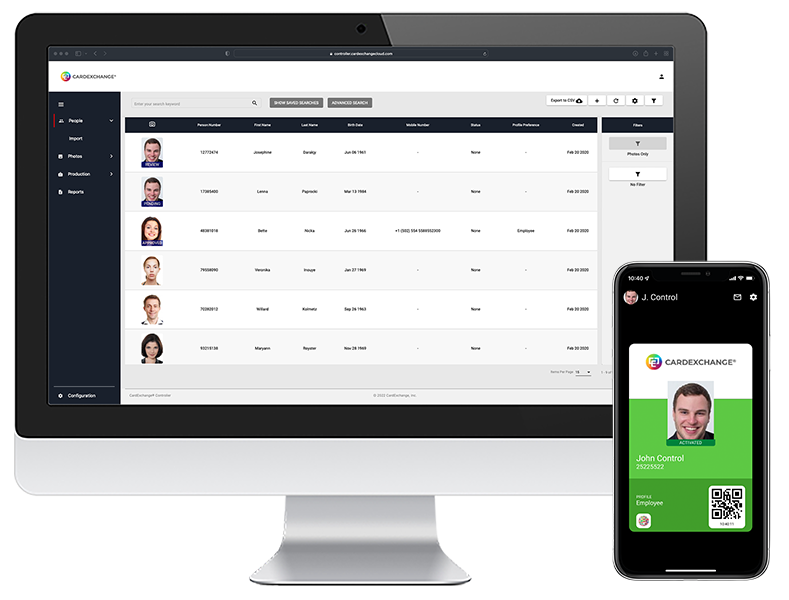
For this project, ADVANTIDGE coordinated the migration of the company’s existing employee database into the CardExchange Controller module.
Using the Bridge Connector, the existing local database was exported and imported into the cloud environment as part of the initial transition.
This provided a centralized location for managing employee records rather than relying on information stored on a single workstation.
The cloud-based architecture also allowed authorized users to access the system through a browser from different workstations without requiring the traditional installation and maintenance of a standalone ID software application on every computer.
Compatibility with the company’s Microsoft Entra environment was an important consideration in selecting the platform, helping align ID management with the organization’s broader IT strategy.
Improving Employee Photo Collection with CardExchange Admission
One of the more interesting requirements came from the company’s management team.
Many employees had been with the organization for years, and their existing ID photographs were outdated. Rather than having employees visit a central office for new pictures, management wanted a convenient way to request updated photographs directly from each employee.
ADVANTIDGE implemented the CardExchange Admission module to support this process.
Admission allows the organization to send personalized, branded email invitations requesting that employees submit updated photographs.
Employees can then provide their own images through the designated submission process, following the organization’s requirements for acceptable photographs.
This helps address several common problems with employee photo collection:
- Employees can submit photographs without traveling to an ID card issuance location.
- The organization can communicate directly with employees using its own branding.
- Image requirements can be established to help ensure submitted photographs are suitable for ID card production.
- Updated photographs can be associated with the appropriate employee records.
- HR and Security teams can reduce the administrative effort involved in collecting and organizing images.
For organizations with multiple offices or a large employee population, this can be a significant improvement over scheduling individual photo sessions or manually collecting pictures through email.
It also helps create a more current and consistent employee directory.
Distributed Card Printing and RFID Encoding with CardExchange Press
Once employee records and photographs are established in Controller, the next step is producing the physical identification credentials.
The CardExchange Press module provides the card production interface and can be accessed from authorized workstations connected to the designated ID card printer.
For this project, the printing configuration included an HID FARGO HDP5000e retransfer card printer equipped with an OMNIKEY encoder.
The HDP5000e is designed for high-quality retransfer printing, making it particularly well suited for organizations that require professional-looking credentials with consistent image reproduction and durable card construction.
The integrated encoding workflow also allows authorized users to interact with RFID technology as part of the card issuance process.
Using the OMNIKEY encoder, the operator can read the RFID chip and capture the associated credential information. That information can then be returned to CardExchange Controller, where it can be stored as part of the employee’s centralized record.
This is an important distinction between a conventional ID card printing application and a more complete enterprise credential management solution.
The physical card is only one part of the process. The associated credential data also needs to be managed, maintained, and made available to other systems that rely on it.
Preparing for PACS Integration and Bidirectional Data Exchange
The real estate firm’s project also included plans for integration with its new Physical Access Control System.
The goal was to establish a workflow in which employee identity information and RFID credential data could be exchanged between the ID management platform and the access control environment.
With the planned API connector, the organization can work toward a turnkey integration that supports bidirectional data exchange.
This is particularly valuable in enterprise environments where multiple systems need to recognize the same employee identity.
For example:
- An employee record is created or updated in the central ID management system.
- The employee’s photograph and identification information are maintained in Controller.
- The ID card is produced through Press.
- The RFID credential is read or encoded and associated with the employee record.
- The credential information can be exchanged with the PACS platform.
- Updates made through the connected systems can be synchronized according to the integration’s supported workflows.
The exact capabilities depend on the API connector, supported data fields, and the integration architecture. However, establishing this foundation during the initial project helps avoid creating another isolated system that must be manually maintained.
A Management Priority: Knowing Every Employee by Face
One of the most important requirements in this project was not a technical specification.
From the beginning, management emphasized that they wanted to see everyone’s face.
Their objective was simple but meaningful: when employees arrive at the office, management wants to recognize them and greet them personally, especially new hires who may be meeting the leadership team for the first time.
This requirement influenced the overall solution design.
The printed access control ID badge would display the employee’s photograph prominently, making visual identification easier throughout the workplace.
At the same time, the centralized employee directory would provide management with convenient browser-based access to employee photographs from different devices.
This creates value beyond physical security. A well-designed employee ID program can help support workplace culture, employee engagement, and a more welcoming onboarding experience.
It is a good example of why understanding the organization’s business objectives is just as important as selecting the right software and hardware.
The key takeaway: Cloud-based ID management can provide a more flexible operating model for organizations that want centralized employee records, browser-based access, streamlined photo collection, RFID credential management, and integration with other enterprise systems.
Comparing On-Premises Enterprise Software and Cloud-Based ID Management
Both projects addressed the same fundamental problem: moving beyond a single computer and allowing multiple authorized users to participate in the employee identification process.
However, the technology choices were different because the organizations had different requirements and existing infrastructure.
| Consideration | Asure ID Enterprise | CardExchange Cloud Suite |
|---|---|---|
| Deployment model | Locally installed application | Cloud-based platform |
| User access | Licensed workstations | Browser-based access |
| Employee records | Shared database architecture | Centralized cloud Controller |
| Photo management | Direct camera capture using TWAIN | Admission employee photo submissions |
| Card production | Local printer-connected workstations | Press module |
| RFID credentials | Depends on printer and encoder configuration | Integrated credential workflow |
| Best fit | Organizations retaining an established on-premises environment | Organizations seeking centralized cloud-based ID management |
| Expansion | Additional licensed workstations and compatible equipment | Additional users, modules, and connected workflows |
Neither approach is universally better.
For organizations already invested in HID Asure ID, Enterprise may provide an efficient and economical way to expand existing operations.
For organizations moving toward cloud-based infrastructure, CardExchange Cloud Suite may provide a more suitable long-term architecture.
The important consideration is selecting a platform that supports the organization’s actual workflow, not simply choosing software based on the number of computers that need to print cards.
Enterprise ID Management Goes Beyond Printing Identification Cards
As employee identification programs become more sophisticated, the value of a centralized ID management platform extends well beyond producing plastic cards.
A properly designed enterprise solution can become an important part of an organization’s broader identity and security infrastructure.
Integration with Physical Access Control Systems
Employee ID badges frequently incorporate RFID technology used for building access, restricted areas, parking facilities, and other physical security applications.
Connecting the ID management platform with PACS can help reduce duplicate data entry and improve consistency between employee records and access credentials.
Visitor Management Integration
Organizations that manage employee credentials centrally may also benefit from connecting employee records to visitor management platforms.
This can help streamline visitor registration, host identification, employee directories, and other workflows where knowing who works at a facility is important.
Multi-Factor Authentication and Secure Logon
Many organizations are also expanding their use of employee credentials for secure workstation and network authentication.
Depending on the credential technology and supported systems, smart cards, FIDO2 security keys, and other authentication solutions can complement an enterprise identification strategy.
Solutions involving HID Crescendo, HID DigitalPersona, and other authentication platforms can help organizations connect physical identity management with logical access security.
The architecture and credential technology must be evaluated carefully to ensure compatibility with the organization’s authentication requirements.
Centralized Employee Identity and HR Workflows
When employee identity records are maintained in a centralized system, there are opportunities to improve processes involving new hires, transfers, terminations, replacement badges, and employee information changes.
Integration with HR applications and other business systems can help reduce manual administration and keep employee information consistent across the organization.
These capabilities are particularly important for companies with multiple facilities, frequent employee turnover, or complex security requirements.
How ADVANTIDGE Approaches Enterprise ID Card Software Projects
No two enterprise ID card projects are exactly alike.
Some organizations simply need to add several additional workstations and printers. Others need to replace an aging standalone system with a cloud-based platform that supports multiple departments, locations, and integrations.
The difference between a successful implementation and an expensive collection of disconnected components often comes down to planning.
With more than 25 years of experience in employee identification and security solutions, ADVANTIDGE takes a consultative approach to understanding how each organization operates before recommending a particular software platform or equipment configuration.
Our process typically involves coordinating with the people responsible for different parts of the application.
Management helps define the business objectives, employee experience, reporting requirements, and long-term goals.
IT teams evaluate network architecture, database management, browser access, cloud infrastructure, authentication, workstation requirements, and integration capabilities.
Security teams focus on credential technology, physical access control, card issuance procedures, and the security of employee identity information.
HR and administrative teams provide insight into employee onboarding, photograph collection, record maintenance, replacement cards, and daily operational requirements.
By bringing these perspectives together, we can help design a solution that addresses the entire employee identification lifecycle.
That may include:
- Evaluating existing ID card software and determining whether an upgrade is practical.
- Designing multi-user licensing and distributed workstation configurations.
- Selecting appropriate HID FARGO, Evolis, IDP, or other professional ID card printers.
- Integrating credential cameras and standardized photo capture stations.
- Establishing consistent card designs across multiple facilities.
- Implementing cloud-based employee record management.
- Configuring RFID encoding and credential management.
- Planning integration with physical access control and visitor management systems.
- Evaluating multi-factor authentication and secure logon requirements.
- Coordinating equipment, software, implementation, and ongoing support.
Our objective is not to sell an organization more software licenses or printers than it needs. It is to understand the challenges, recommend the right architecture, and coordinate the components required to make the complete solution work.
Planning Your Next Enterprise ID Management Upgrade
If your organization is still relying on a single workstation to manage employee records and print identification cards, it may be time to evaluate what a more distributed or centralized solution could accomplish.
Whether you have an established HID Asure ID application that needs to support additional locations or are considering a transition to a cloud-based platform such as CardExchange Cloud Suite, there are practical ways to modernize your ID card program without unnecessarily complicating the process.
The two projects described above demonstrate that enterprise ID management does not have to follow a one-size-fits-all approach.
One organization expanded its existing software investment through Asure ID Enterprise, standardized its printing equipment, and established consistent photo capture across multiple campuses.
Another moved from a standalone workstation to a cloud-based environment with centralized employee records, employee-submitted photographs, distributed card production, RFID credential management, and a foundation for PACS integration.
Both solutions started with the same principle: understand how the organization needs to manage employee identities today, and build an architecture that can support where it is going tomorrow.
ADVANTIDGE has been helping organizations solve complex ID card and credential management challenges for more than 25 years. We work with management, IT, HR, and Security teams to develop practical solutions that bring together ID card software, printers, credential technology, access control, visitor management, and secure authentication.
If you are planning an upgrade to your employee ID card system, adding new facilities, or looking to integrate your identification program with other enterprise applications, contact ADVANTIDGE to discuss your requirements.
We will help you evaluate your existing environment, identify the right technology, and develop a solution that works for your organization.