Upgrading from HID FARGO HDP5000 & HDP8500: What You Need to Know About the Next Generation of Retransfer ID Card Printers
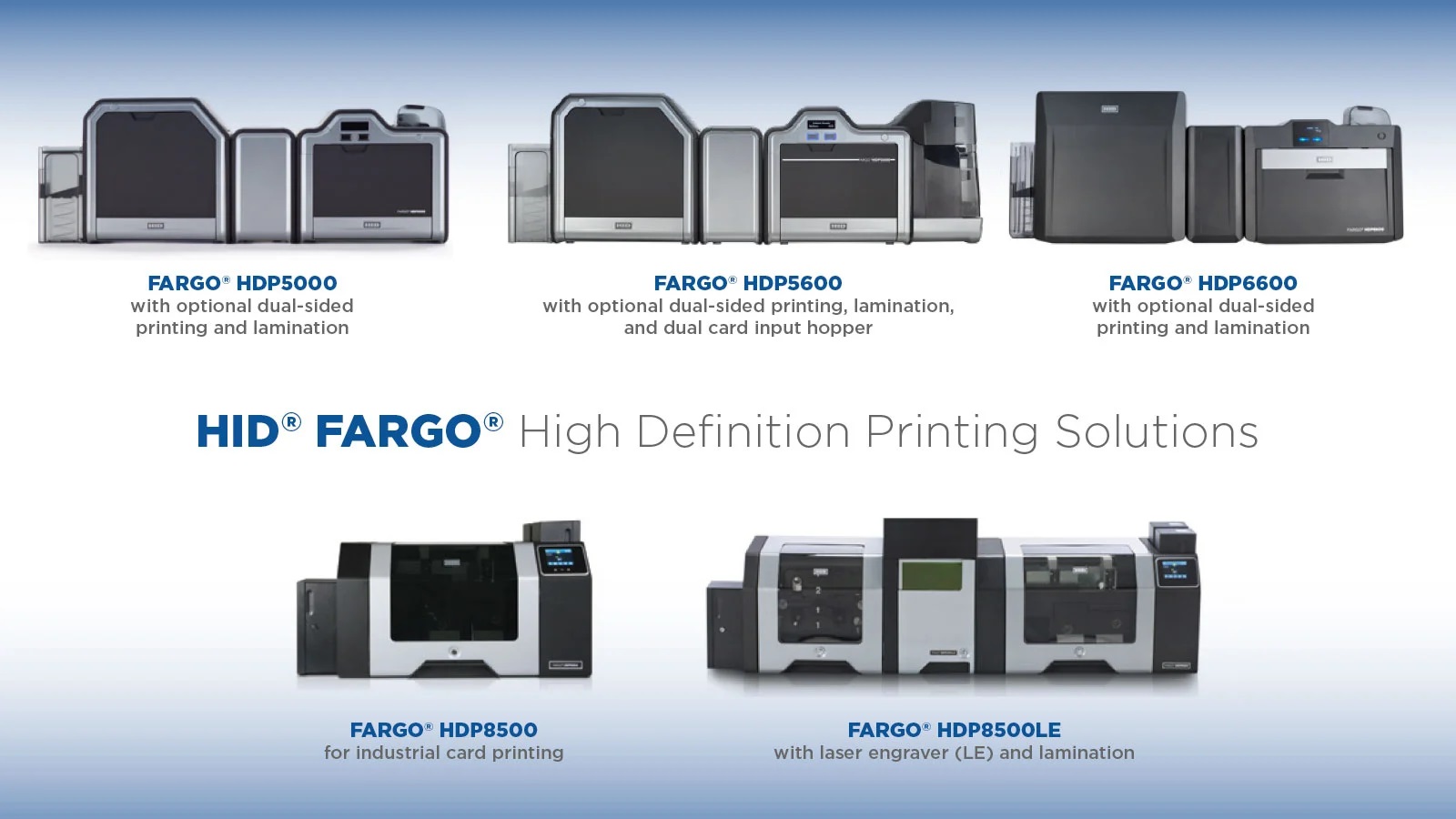
For more than a decade, HID FARGO’s HDP5000 and HDP8500 have been foundational technologies across some of the most demanding ID card issuance environments in the world. From healthcare systems and government agencies to advanced manufacturing and high-tech campuses, these printers have delivered the consistent, high-quality output required for secure credentialing programs that use HID access control badges.
However, both the HDP5000 and HDP8500 have been discontinued and reached end-of-life (EOL) status, creating a critical inflection point for organizations that rely on daily badge issuance and cannot afford operational disruption.
At ADVANTIDGE, we’re seeing a significant increase in questions about when customers need to upgrade. Let’s break down what this transition means, what’s changed in the latest generation, and how to approach it strategically.
The Reality of End-of-Life: Risk Increases Over Time
While consumables such as film and ribbons remain available, the bigger concern is serviceability:
- Replacement parts for HDP5000 are still available but lead times are getting longer
- Replacement parts for HDP8500 are no longer stocked
- Repair timelines are taking longer and becoming unpredictable
- Downtime risk increases with each failure event
- Legacy firmware and driver limitations can create compatibility issues with modern systems (no updates for Windows 11)
For organizations printing daily credentials tied to access control systems, this is not a minor inconvenience—it’s a business continuity risk.
Core Use Case: Secure, Dual-Sided Smart Card Issuance
Both legacy models have been widely used for:
- Dual-sided printing on access control cards
- Technologies including:
- HID Prox
- iCLASS / iCLASS SE
- Seos
- MIFARE DESFire and other contactless smart cards
- Inline encoding with embedded encoders
- Integration with:
- Access control systems
- ID badging platforms like Asure ID Exchange
These requirements haven’t changed—but expectations around speed, reliability, and image quality absolutely have.
The Next Generation: HDP5000e and HDP6600
HID has introduced two new platforms to replace the legacy models:
Both leverage updated retransfer technology with substantial gains in performance, durability, and output quality.
HDP5000e: Proven Platform, Modernized
The HDP5000e builds on the architecture that made the HDP5000 so widely adopted, while addressing long-standing limitations.
Key Specifications & Improvements
- Print Method: Retransfer (HDP) technology
- Resolution: 300 dpi
- Print Speed:
- ~24 seconds per card (YMCK, single-sided)
- Dual-Sided Printing: Standard or field-upgradable
- Card Compatibility:
- PVC, composite PVC/PET, ABS, polycarbonate*
- Encoding Options:
- Prox, iCLASS, Seos, MIFARE, DESFire, mag stripe
- Connectivity:
- USB + Ethernet standard
- Modularity:
- Field-upgradeable modules (dual-sided, lamination, encoding)
- Warranty:
- 4 years (33% increase over prior generation)
Where It Fits Best
- Mid-to-large organizations
- Distributed badge issuance environments
- Applications requiring high image fidelity and encoding reliability
HDP6600: A True Performance Leap
The HDP6600 is not just a replacement—it’s a step-change in retransfer printing performance.
Designed for high-volume environments, it introduces faster throughput, higher resolution, and enhanced process automation.
Key Specifications & Improvements
- Print Method: High-speed retransfer (HDP)
- Resolution: 600 dpi
- Print Speed:
- First card out: < 60 seconds
- Batch mode: < 20 seconds per card
- More than 2x faster than HDP8500
- Dual-Sided Printing: Standard or field-upgradable
- High-Capacity Input Hopper:
- Up to 200 cards
- Enhanced Reliability Features:
- Multiple cleaning rollers integrated into print path
- Improved heat management for long runs
- Encoding Options:
- Full inline encoding support (Prox, iCLASS, Seos, DESFire, etc.)
- Connectivity:
- USB, Ethernet
- Warranty:
- 4 years (33% increase over prior generation)
Where It Fits Best
- Centralized badging operations
- High-volume print environments
- Organizations that “cannot afford to be down”
- Applications requiring high-definition imagery (photo IDs, brand-sensitive credentials)
Why Organizations Are Upgrading Now
Across industries, we’re seeing a consistent pattern:
Customers are not waiting for failure—they’re upgrading proactively.
The drivers are clear:
- Aging hardware with increasing failure rates
- Lack of replacement parts
- Higher cost of reactive downtime vs. planned upgrade
- Significant gains in:
- Speed
- Reliability
- Print quality
- Warranty coverage
For environments printing hundreds or thousands of cards per week, the HDP6600’s throughput alone can justify the investment.
Materials Matter: Card Construction Impacts Output
Retransfer printing is highly versatile—but material selection still plays a critical role.
Best Practice
- Use composite PVC cards (PVC + PET core)
Why It Matters
- Improved heat resistance during retransfer process
- Reduced warping, especially for single-sided printing
- Better long-term durability
Potential Issue
- 100% PVC cards may exhibit slight warping if:
- Printed on one side only
- No flattener module is present
ADVANTIDGE works directly with customers to validate card stock compatibility before deployment.
Support Infrastructure: Where ADVANTIDGE Adds Value
Upgrading hardware is only part of the equation. Maintaining uptime is where experienced support becomes critical.
With over 25 years focused on security identification solutions, ADVANTIDGE provides:
Technical Support
- Factory-trained technicians
- Advanced diagnostics using FARGO Workbench
- Remote troubleshooting to resolve issues without shipping when possible
Service Programs
- One-time service tickets
- Annual support plans
- Priority response options
Logistics Coordination
- Prepaid shipping labels
- Managed RMA processes
- Repair tracking and communication
For organizations with distributed locations or high dependency on badge issuance, this level of support becomes a force multiplier.
Field-Serviceable Advantage: Reducing Downtime
One of the most overlooked benefits of newer HID FARGO platforms is improved field serviceability.
Using FARGO Workbench and guided support:
- Firmware updates can be managed remotely
- Calibration and diagnostics can be performed on-site
- Many issues can be resolved without removing the printer from operation
This directly translates to:
- Lower total cost of ownership
- Reduced operational disruption
- Faster resolution cycles
Validation Before You Commit
Every environment is different. That’s why ADVANTIDGE offers:
- Free custom printed card samples
- Side-by-side comparison with your current printer
- Validation of:
- Image quality
- Color accuracy
- Card compatibility
- Encoding performance
This ensures that any transition is grounded in real-world output—not just specifications.
Strategic Takeaway
If your organization is still running an HDP5000 or HDP8500, the question is no longer if you should upgrade—it’s when and how.
The transition to the HDP5000e or HDP6600 delivers:
- Measurable performance gains
- Improved reliability
- Extended warranty protection
- Better supportability in modern IT environments
For organizations where ID issuance is tied directly to security, access, and daily operations, delaying this transition introduces unnecessary risk.
Final Word
ADVANTIDGE partners directly with IT and security teams to ensure that credential issuance systems are not just functional—but dependable, scalable, and aligned with long-term operational needs.
Whether you’re managing a single site or a multi-location enterprise, the goal remains the same:
Consistent, high-quality, secure ID badges—without interruption.
If your current system isn’t delivering that, it’s time to evaluate what the next generation can do.