Enterprise organizations are under constant pressure to improve security posture while reducing operational friction. One of the most common—and often underestimated—opportunities for optimization lies in the ID issuance workflow. Specifically, encoding ID badges directly in the print process eliminates manual steps, reduces human error, and ensures that newly issued credentials function immediately across physical and logical access systems.
At ADVANTIDGE, this requirement for encoding ID badges frequently comes from IT and security teams responsible for maintaining compliance, managing access control systems, and supporting employee onboarding at scale.
The Integrated Badge Issuance Workflow
A fully integrated badge issuance solution consists of three core components:
-
ID Card Printer with Embedded Encoder
-
Access Control Credentials (Cards)
-
Software for Data Management and Encoding Logic
Each component must align at both the hardware and protocol level to ensure successful read/write operations during encoding of ID badges and printing.
1. ID Card Printers with Embedded Encoders
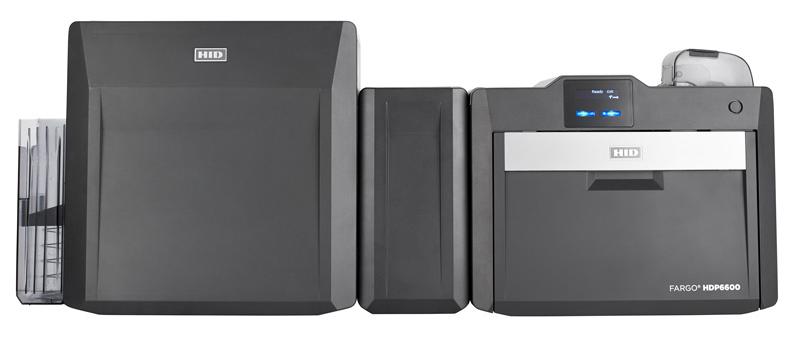
Modern enterprise-grade printers, such as the FARGO HDP6600, support inline encoding modules that allow credentials to be read from and written to as they pass through the print engine.
Key Capabilities:
-
Inline Encoding: Simultaneous printing and chip/antenna interaction
-
Modular Design: Field-upgradable encoder modules
-
Multi-technology Support: LF, HF, and contact smart cards
Encoder Specifications:
-
Low Frequency (LF): 125 kHz proximity reading (read-only in most cases)
-
High Frequency (HF): 13.56 MHz read/write capabilities
-
Interface Standards: ISO/IEC 14443 (Type A/B), ISO/IEC 15693
-
Typical Encoder Hardware: OMNIKEY 5127CK or similar embedded modules
A common question from enterprise teams is whether these encoders can “pick up” credential data automatically during printing. The answer depends on both the card technology and the encoder configuration.
For example:
-
125 kHz prox cards can typically be read (CSN extraction) but not written.
-
HF smart cards can be both read and written, depending on security keys and memory structure.
2. Access Control Credential Technologies
Understanding credential technology is critical because encoding capabilities vary significantly.
Low Frequency (125 kHz Proximity)
-
Common format: HID Prox
-
Specification:
-
Frequency: 125 kHz
-
Data: Pre-programmed, read-only
-
Output: Card Serial Number (CSN)
-
-
Use Case: Legacy systems
-
Limitation: Cannot be written during print—only read and captured
High Frequency (13.56 MHz Smart Cards)
iCLASS
-
Standard: ISO/IEC 15693 / proprietary
-
Memory: Segmented, secure sectors
-
Capability: Read/write with proper keys
Seos
-
Platform: Secure Identity Object (SIO)-based
-
Encryption: AES-128
-
Use Case: Mobile + physical access convergence
MIFARE DESFire EV1/EV2/EV3
-
Standard: ISO/IEC 14443 Type A
-
Encryption: 3DES / AES
-
Memory: Up to 8KB
-
Capability: Fully read/write with application-level structure
FIDO2 Credentials
-
Standard: FIDO2 / WebAuthn
-
Use Case: Passwordless multi factor authentication
-
Integration: Logical access for secure logon to devices, networks and more
-
Requirement: Middleware/software orchestration like HID CMS or Digital Persona
3. Software: The Critical Integration Layer
The software layer is often the most complex and the most limiting.
Standalone Issuance Platforms
Solutions like Asure ID Exchange provide robust encoding workflows when paired with compatible hardware like FARGO printers and OMNIKEY encoders.
Capabilities:
-
Direct encoder control
-
Data mapping to card memory
-
Workflow automation
-
Database integration
This setup is ideal when organizations want full control over the issuance process independent of their PACS for encoding ID badges.
PACS-Integrated ID Badge Printing
Many enterprise environments rely on Physical Access Control Systems which may include badge design and issuance modules.
However, limitations often arise:
-
Restricted encoder support (vendor-specific hardware requirements)
-
Limited ability to write to card memory
-
Inconsistent support for reading CSN during print
-
Database write-back constraints
Example Constraint:
LenelS2 requires a proprietary-configured OMNIKEY encoder that needs to be sourced through them rather than a standard embedded version—even if the hardware specifications appear identical on the HID FARGO parts list.
Real-World Application: Solving for Prox + Print
A common enterprise question:
“Does the FARGO HDP6600 support an in-line reader that will pick up a 125 kHz prox number during printing?”
Technical Answer:
Yes—with the correct encoder module installed, the printer can read the prox CSN during the print cycle.
Requirements:
-
LF encoder module installed in printer
-
Compatible card stock (125 kHz prox)
-
Software capable of:
-
Capturing CSN during print
-
Writing that value to the employee record in the PACS database
-
Key Consideration:
Even if the printer supports the function, the software must be able to ingest and map that data. This is where most deployments fail without proper planning.
Business Impact
When implemented correctly, this integrated workflow delivers:
-
Elimination of manual data entry
-
Reduction in credentialing errors
-
Faster onboarding and badge issuance
-
Improved security and auditability
-
Seamless user experience (badge works immediately)
Planning & Implementation Considerations
Because every deployment involves a unique combination of:
-
Card technology
-
Printer hardware
-
Encoder modules
-
PACS software
…it is essential to validate compatibility across all layers before procurement.
ADVANTIDGE routinely works with IT and security stakeholders to:
-
Validate encoder compatibility
-
Confirm PACS capabilities
-
Design data workflows
-
Configure hardware/software integrations
FAQ
Can all ID card printers read and write access control badges?
No. Only printers with embedded encoder modules (LF or HF) can perform read/write operations. The base printer must be configured with the appropriate encoder.
Can prox (125 kHz) cards have numbers programmed during printing?
No. In most cases standard prox cards come pre-programmed and are read-only. A card printer with an embedded encoder can read the CSN, but encoding is not usually possible unless you have an actual prox programmer, not a standard encoder.
What card technologies support writing to the smart chip during print?
High-frequency smart cards such as:
-
iCLASS
-
Seos
-
MIFARE DESFire
These support secure read/write operations with proper key management.
Why doesn’t my access control software support encoding?
Many PACS platforms have limited encoding support or require proprietary hardware. Always verify:
-
Supported encoders
-
API/database write-back capabilities
-
Card technology compatibility
Is standalone software better than PACS-integrated badging?
It depends on the use case:
-
Standalone (e.g., Asure ID Exchange): More flexible, better for complex encoding
-
PACS-integrated: Simpler workflows but often limited functionality
What is the biggest risk in deploying this solution?
Lack of compatibility between hardware and software components. This can result in:
-
Failed encoding
-
Missing data
-
Non-functional badges
Conclusion
Encoding ID badges for access control credentials during the print process is not just a convenience—it’s a strategic upgrade to your organization’s security infrastructure. When properly implemented, it bridges physical and logical access while eliminating inefficiencies that scale poorly in enterprise environments.
With over two decades of experience, ADVANTIDGE helps organizations architect these solutions correctly the first time—ensuring every badge issued is secure, functional, and fully integrated into the broader access control ecosystem.