Creating a safe, healthy, and distraction-free learning environment is a top priority for school administrators, IT leaders, and security professionals. Yet one of the most persistent blind spots on campus continues to be one of the most necessary spaces: student restrooms and changing areas.
These are environments where privacy is expected—and legally protected—which makes traditional surveillance methods like cameras inappropriate. Unfortunately, that same privacy creates an opportunity for misuse.
Today, vaping has emerged as the most widespread issue occurring in these unsupervised areas. And it’s not just a policy violation—it’s a health, safety, and cultural problem that directly impacts the student experience.
This is where HALO Smart Sensors, deployed strategically by changing the equation. With over two decades of experience serving schools with security identification solutions, ADVANTIDGE is committed to supporting safe campuses for everyone.
The Reality: Bathrooms Are Where Vaping Occurs in Schools
The data is clear and consistent:
- 90% of non-vaping students and 70% of vaping students identify bathrooms as the primary location for vaping.
- 55% of teachers report that students known to vape request restroom breaks more frequently than their peers.
From an operational standpoint, this creates a pattern that’s difficult to control. Students can leave class under legitimate pretenses and enter an environment where:
- There is no direct supervision
- Cameras are not permitted
- Detection is extremely difficult using traditional systems and may even cause false alarms
Bathrooms have effectively become a loophole in otherwise well-managed campus security strategies.
Why Traditional Detection Methods Fail
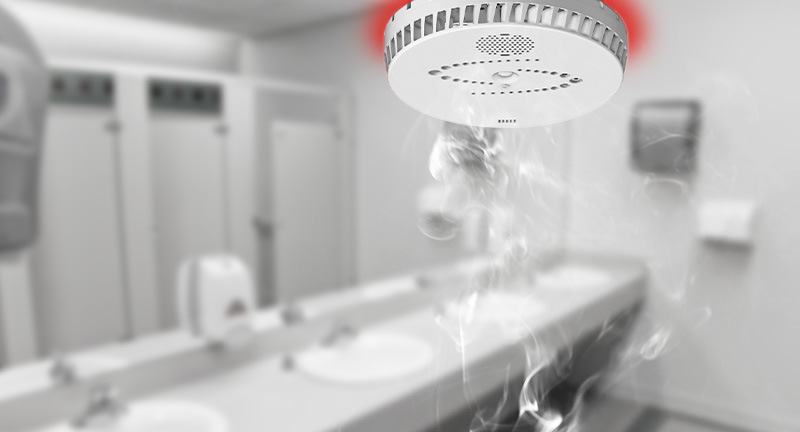
Many schools initially rely on smoke detectors or staff monitoring to address the issue. Both approaches fall short for technical reasons.
E-cigarette vapor behaves very differently from smoke:
- It is not continuously emitted
- It has no consistent odor signature
- It can be masked easily with sprays or perfumes
- It produces low particulate levels, often below smoke detector thresholds
From a detection standpoint, this is a fundamentally different problem. You’re not dealing with combustion—you’re dealing with intermittent aerosolized chemical signatures.
That requires purpose-built sensing technology.
The Health and Safety Implications Go Beyond Policy Violations
While vaping is often framed as a disciplinary issue, the broader implications are more serious:
- Secondhand exposure to aerosolized chemicals and toxins
- Increased likelihood of bullying, vandalism, or altercations in unsupervised areas
- Avoidance behavior—students choosing not to use restrooms due to discomfort or safety concerns
- Long-term normalization of rule-breaking environments
When students begin avoiding basic facilities, you’re no longer dealing with isolated misconduct—you’re seeing systemic impact on campus culture.
HALO Smart Sensors: Designed for Privacy-First Environments
HALO Smart Sensors were engineered specifically for spaces where cameras and microphones are not an option.
They provide situational awareness without surveillance, using environmental intelligence rather than visual monitoring.
Core Capabilities Relevant to Schools
1. Vape Detection (Purpose-Built)
HALO sensors detect specific chemicals and particulate signatures unique to vaping aerosols, dramatically reducing false positives compared to traditional smoke detectors.
2. Real-Time Alerts
Incidents trigger instant notifications to designated staff, enabling rapid response while the event is still actionable.
3. No Audio or Video Recording
This is critical. HALO operates with zero recording capability, preserving student privacy and ensuring compliance with regulations in sensitive areas.
4. Multi-Sensor Intelligence
Beyond vaping, HALO can detect:
- Air quality issues (IAQ)
- Chemical anomalies
- Aggressive noise patterns (e.g., raised voices)
- Motion patterns
- Potential safety threats
5. Cloud-Based Visibility
Through the HALO Cloud platform, administrators gain:
- Event logs
- Time-based trend analysis
- Location-specific insights
- System health monitoring
This turns isolated incidents into actionable intelligence.
Deterrence Is the First—and Most Immediate—Win
In practice, one of the most powerful outcomes of deploying HALO sensors is behavioral.
When students know that:
- Detection is highly likely
- Alerts are immediate
- Enforcement is consistent
…behavior changes quickly.
This shifts bathrooms from “safe zones for rule-breaking” back to their intended purpose.
Just as importantly, it removes the burden from non-vaping students who would otherwise feel pressure to report peers or avoid the space entirely.
Supporting Student Health and Peer Accountability
Technology alone doesn’t solve cultural issues—but it creates the conditions for better outcomes.
Schools that successfully reduce vaping tend to pair detection systems with:
- Student education programs
- Peer-to-peer advocacy
- Clear, consistent policy enforcement
Students are far more likely to respond to messaging from peers and role models within their demographic. When combined with visible enforcement tools like HALO sensors, schools can reinforce both accountability and awareness.
Implementation: What Actually Matters in the Field
From a deployment standpoint, ADVANTIDGE measures success through execution—not just equipment selection.
1. Power and Infrastructure
Hardwired installations are preferred for reliability, but wireless options exist where infrastructure is limited. Battery-powered devices require a defined maintenance cadence.
2. Sensor Placement Strategy
Effective coverage requires understanding behavior patterns, not just floorplans.
Focus on:
- Stalls and enclosed areas
- Known congregation points
- Airflow patterns within the space
Avoid:
- Direct proximity to vents or windows
- High-moisture zones that could skew readings
3. False Positive Mitigation
Even advanced sensors require proper configuration:
- Calibration to environmental conditions
- Routine cleaning (recommended every ~90 days)
- Awareness of nearby aerosol sources
4. System Integration
HALO becomes significantly more powerful when integrated with:
- Access control systems
- Video systems (outside the restroom)
- Mass notification platforms
This enables correlated response workflows, not isolated alerts.
5. Data Utilization
Over time, schools can analyze:
- Peak incident times
- Repeat locations
- Effectiveness of interventions
This allows leadership to shift from reactive enforcement to proactive policy and resource allocation.
Restoring Trust in Shared Spaces
One of the less discussed—but highly impactful—benefits of vape detection is restoring confidence among the broader student population.
When restrooms are perceived as:
- Clean
- Safe
- Monitored (appropriately)
- Free from disruptive behavior
…students return to using them without hesitation.
This is a quality-of-life improvement that directly supports student well-being and daily campus operations.
*Take the next step toward a safer, smarter facility watch the video!
Why Schools Partner with ADVANTIDGE
Technology is only one piece of the solution. Implementation, integration, and long-term support are where most programs succeed or fail.
For over 20 years, ADVANTIDGE has worked alongside:
- School districts
- Private institutions
- IT and security teams
…to design and deploy solutions that align with real-world operational needs.
The approach is consultative by design:
- Identify gaps in current processes
- Understand stakeholder priorities (administration, IT, facilities, security)
- Recommend fit-for-purpose solutions
- Ensure systems integrate cleanly with existing infrastructure
- Support ongoing optimization and scalability
In many cases, schools are able to improve safety while reducing inefficiencies and operational friction—a critical balance in today’s resource-constrained environments.
*Check out our case study with a southern California school district
A Practical Path Forward
Addressing vaping in schools is not about over-surveillance or punitive systems. It’s about restoring balance:
- Privacy where it’s required
- Accountability where it’s lacking
- Visibility where there are blind spots
HALO Smart Sensors provide a technically sound, privacy-conscious way to close one of the most persistent gaps in campus safety.
When deployed correctly—and supported by the right partner—they do more than detect incidents. They help reshape behavior, improve health outcomes, and give students back a space that should have never been compromised in the first place.